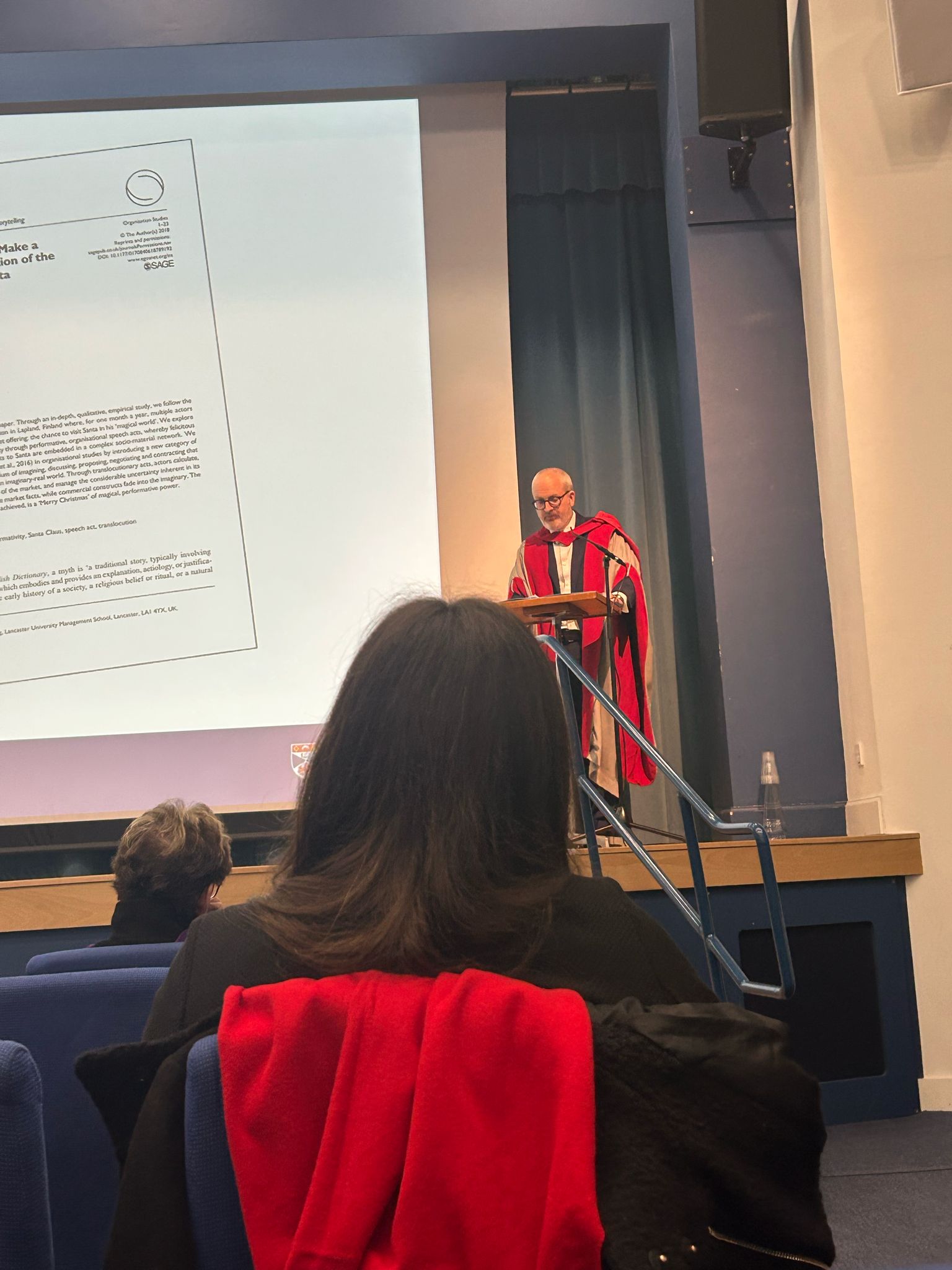
Well, it was a busy 2025, but that’s no excuse. So here it is. On 19 February 2025, I was honoured to take part in an inaugural lecture showcase for the University of St Andrews Business School, alongside my colleagues Professors Alina baluch, Shiona Chillas and Ian Smith. We were introduced by the Principal, Professor Dame Sally Mapstone, while Dean of Arts Professor Catherine O’Leary was our MC. A very special, happy event, followed by a dinner in Upper College Hall.
The lecture has since been published as a commentary piece – and call to action – in the Journal of Cultural Economy, which I edit. It’s open access, available here or as a PDF.
For those who prefer, here’s the text and a few pictures:
“The times they are a-changin’: markets after neoliberalism, and how to study them”
You will doubtless know that it is possible, in the run up to Christmas each year, to take a day trip to see Santa Claus in his cottage in Lapland.[i] You and your children hop on an aeroplane and over the next few hours you are transported into a magical world of snowy forests, sleighs, and reindeer – not to mention merchandising opportunities – until, much later that day, you tumble back into Birmingham, Manchester or Gatwick, pockets empty but memories overflowing.
If you believe in Santa, you should probably stop listening now. For this particular market, offering an authentic Santa experience, is an enormously complicated organisational achievement. A network of local operators serves it: the husky tours, snowmobile transport, hotel and gift shop, buses, and the other paraphernalia of tourism. The actors playing Santa are recruited in the UK so that they will be familiar with the latest trends of the toy market and responsive to the vernacular demands of their small visitors. Authenticity is key, lest the visitors complain (again) about ‘a posh English Santa with a false beard.’
The whole is immaculately choreographed. Tourists take a sleigh ride across the frozen lake into the torchlit forest. Elves shepherd them into the cottage for a carefully scripted four-minute encounter with the man himself, out again into the sleigh, and back through the forest, tears in their eyes at the whole magical performance. Some days two flights arrive from different airports. On those days there are two Santas at work, hidden in different locations in the wood, managed by different circuits of elves, the passengers themselves identified by coloured badges on the lapels.
Protests in Hong Kong have captured the world’s attention in recent weeks, with demonstrators closing streets and the airport, and Chinese forces amassing near the border with a none too subtle threat of violent reprisal. The protests began in response to a new extradition law, but have spilled over into a general unease about the future of Hong Kong’s special administrative status.
This special status sets Hong Kong apart from mainland China in a number of ways. As well as enjoying various social and political freedoms, it has a free market economy and is one of the world’s biggest financial centres. Global finance has attracted a number of Chinese elites but has not benefited a large chunk of Hong Kong society.
But if Hong Kong’s protesters succeed in pushing back against the oversight of Beijing, it would serve to reinforce the benefits the elites already enjoy from Hong Kong’s economic arrangements. This parallels the situation in the UK, where financial elites could soon embrace a low-tax, low-regulation future following a no-deal Brexit driven by populist concerns about immigration and inequality.
Longstanding financial centres
Hong Kong and London share a common history and since the 1960s have flourished as offshore financial centres, acting in many ways as secrecy jurisdictions or tax havens.
Hong Kong’s financial sector was a creation of the British, who used it as a route into Chinese markets. It boomed following the opening of the Chinese economy. When, in 1997, Hong Kong returned to China, it preserved some of this offshore status as a special administrative zone. The beneficiaries this time were Chinese.
Hong Kong stores great reserves of capital in comparative secrecy, channels global investment into China – also in secrecy – and is a crucial part of China’s long-term plan to establish the Renminbi as a global reserve currency through offshore markets. The local “dim sum bond market”, issuing RMB denominated debt, has been a remarkable success, with the equivalent of more than US$100 billion of capital circulating.
Hong Kong has been implicated in shadier dealing. Investigative journalist Nicholas Shaxton puts it bluntly: “Hong Kong is where most of the corruption in China is accomplished.” Other scholars see Hong Kong as an amalgam of onshore and offshore finance, with a strong legal system, tax treaties, and a robust financial market.
London’s success as a global financial centre has also been driven by its status as a hub for offshore financial services, a position greatly supported by its strong connections throughout Britain’s former empire. In the 1960s and 1970s, for example, London became home for the “eurodollar” markets. These were lending markets operating in US dollars, located in London but considered to be beyond the purview of the UK’s legislation.
London-based lenders could charge higher rates than the national currency controls of the time allowed. The United States benefited as the depth and liquidity of eurodollar markets supported the dollar’s reserve currency status; international banks arrived in droves and the City, London’s financial district, thrived. Regulators on both side of the Atlantic turned a blind eye, quietly admitting the economic benefits the markets bestowed. Even the Soviets invested.
Masters of reinvention
Both London and Hong Kong are centres of perpetual reinvention. Following the financial crisis, the City’s innovations have included managing the wealth of the global super-rich and an arrangement with the Chinese government to develop the offshore trading of the RMB.
In the same way that Hong Kong’s protesters fear Chinese control, a number of Brexiters claim the EU comes with too much red tape. Interviewing financiers for research into London-based markets, I found overwhelming support for Brexit, largely driven by a distaste for increasing layers of regulation.
It is certainly the case that Europe has never been comfortable with London’s activities as a conduit for international funds. No one expects the EU to maintain the City’s “passporting rights” which allow firms based in the UK to trade freely across the EU. And the mundane but profitable business of settling euro transactions is likely to be pulled within the bloc.
But there is much more to financial markets than regulation. The City’s remarkable talent for reinvention flows from the nature of financial markets themselves.
History shows they are fluid entities constantly reshaping in response to political happenstance and technological or economic advances. Markets put down roots in the shape of dense social networks shaped by bonds of trust and expertise, and in the material infrastructures – from wires, phones and screens to upscale offices, restaurants and hotels – without which they cannot function. Advantages of status and connection become embedded. When new financial frontiers open up it’s those well-placed who benefit.
Here’s the irony. Hong Kong’s protesters seek political freedom, but whatever happens in politics, it is likely that the economic advantages of the elite will be preserved through the social and material architectures of its markets.
Brexit, meanwhile, has been driven by concerns over immigration and inequality, but the no-deal on the horizon offers something else. If the new prime minister’s rhetoric of “boosterism” and “freeports” is to be believed, the City will be entirely unencumbered by regulation, free to roam the high seas of international currency flows. Here too, only the financial elites will benefit.
For the last two years I have been working on a ‘historical sociology’ of two stock markets established in London in 1995 in response to a series of rule changes at the London Stock Exchange (LSE).
The first, the Alternative Investment Market, or AIM, was set up by the LSE. It was established as part of LSE chief executive Michael Lawrence’s ‘seven-point plan’ for the repositioning of the Exchange as an engine for economic growth focused on the UK regions. AIM was also, in part, a reactive move allowing the Exchange to deal with competitive threats in Europe and at home, particularly growing activity under its own Rule 535. It has acted as a proving ground for many smaller companies and plays an important role in the political positioning of the LSE.
The second, OFEX (renamed PLUS in 2004) was privately operated and driven by commercial demand. Originally operated as a trading facility, it achieved legal recognition as a ‘designated market’ in 2001, and then as a Recognized Investment Exchange (RIE) in 2007. As OFEX it coexisted with the LSE and rode the dotcom wave; as PLUS it served as a vehicle for a market rebellion against the LSE. It struggled to maintain a commitment to its original small company constituency and to compete as a trading venue of choice against the Exchange. While AIM has flourished, PLUS faltered after the financial crisis of 2008, and my narrative finishes in 2012 with the sale of the PLUS RIE licence to ICAP, now NEX.
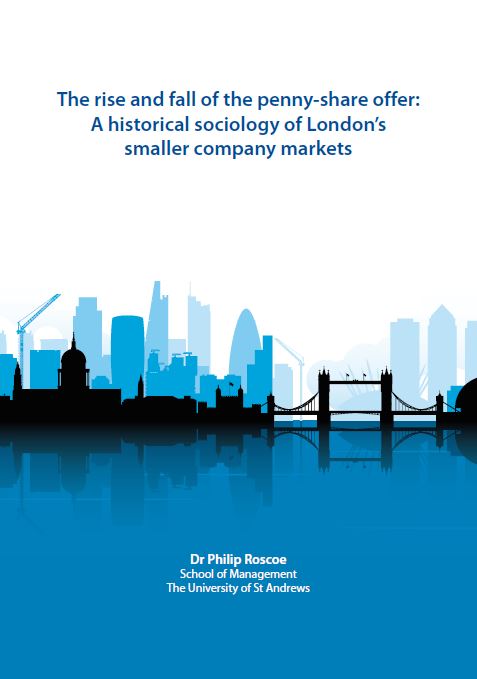
My research is based on interviews with members of the small company stock market community, as well as extensive documentary records. I have compiled a narrative account of these markets designed primarily for interested academics and for members of the professional community. It’s freely available and you can download it here. My narrative begins on the old floor of the LSE prior to the 1986 ‘Big Bang’ and finishes with the failure of PLUS in 2012. I conclude with some brief reflections upon the challenges and opportunities facing stock markets serving the smaller company sector, as illuminated by this history.
Please feel free to download, circulate, and quote. Suggested citation: Roscoe , P J 2017 , The rise and fall of the penny-share offer : A historical sociology of London’s smaller company markets. University of St Andrews.


 Philip Roscoe