
‘How to Build a Stock Exchange’, a public lecture at The Australian National University (and on ABC National radio!)

In March and April 2025 I was fortunate enough to spend a month in Canberra as a visiting fellow at The Australian National University’s prestigious Research School for Social Sciences. Fine colleagues in the School of Sociology made me welcome and Canberra delighted me, with its lake, trees and hot air balloons. But a highlight was a public lecture I gave on 26 March 2025, recorded by ABC National, and I’m sharing the script here. The radio recording precluded slides, so I’ll add in some images that I might have used. Enjoy!

Update! The lecture was brodcast on ABC National in October. You’ll find it here!

Canberra is famous for its autumn hot air balloon rally!

Good evening, thank you all for coming tonight, and for that generous introduction.  I’d like to thank the Research School for Social Sciences for offering me a fellowship, and the chance to spend a month in Canberra; to the Journal of Cultural Economy for the not inconsiderable contribution of getting me here; and to colleagues in the department of sociology and the department of management for the warm welcome that I have received over the last weeks. Thank you also to ABC Radio National for recording this lecture.   

A generous introduction from Professor Melinda Cooper

I too would like to acknowledge that we are meeting on land belonging to the Ngunnawal (Nunnawal) and Ngambri (nambri) people, to recognise that sovereignty was never ceded, and to pay respect to their Elders past and present.

The acknowledgement of country seems to me, a visitor from the other side of the world, a welcome recognition and acceptance of the difficult history of colonialism. In that same spirit of recognition, I would like to take you from a massacre to a legal trial and a personal connection to the murky history of finance, which can – should you wish – be told as a history of colonial exploitation. Indeed, even if you don’t wish, it still must be.

Continue reading “‘How to Build a Stock Exchange’, a public lecture at The Australian National University (and on ABC National radio!)”
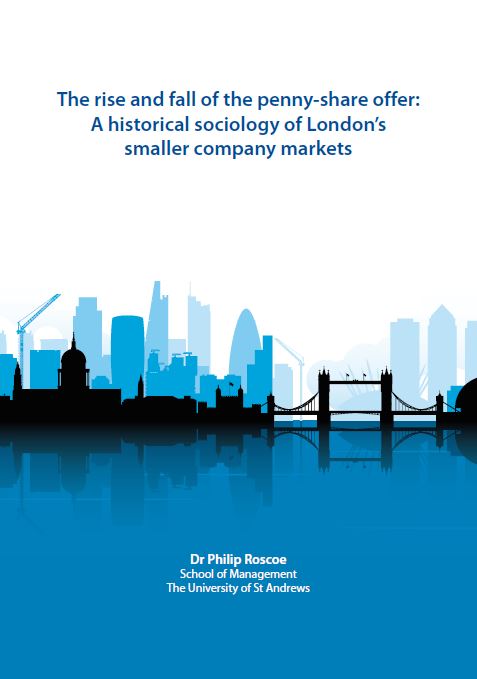
The rise and fall of the penny-share offer : A historical sociology of London’s smaller company markets

For the last two years I have been working on a ‘historical sociology’ of two stock markets established in London in 1995 in response to a series of rule changes at the London Stock Exchange (LSE). Roscoe report cover

The first, the Alternative Investment Market, or AIM, was set up by the LSE. It was established as part of LSE chief executive Michael Lawrence’s ‘seven-point plan’ for the repositioning of the Exchange as an engine for economic growth focused on the UK regions. AIM was also, in part, a reactive move allowing the Exchange to deal with competitive threats in Europe and at home, particularly growing activity under its own Rule 535. It has acted as a proving ground for many smaller companies and plays an important role in the political positioning of the LSE.

The second, OFEX (renamed PLUS in 2004) was privately operated and driven by commercial demand. Originally operated as a trading facility, it achieved legal recognition as a ‘designated market’ in 2001, and then as a Recognized Investment Exchange (RIE) in 2007. As OFEX it coexisted with the LSE and rode the dotcom wave; as PLUS it served as a vehicle for a market rebellion against the LSE. It struggled to maintain a commitment to its original small company constituency and to compete as a trading venue of choice against the Exchange. While AIM has flourished, PLUS faltered after the financial crisis of 2008, and my narrative finishes in 2012 with the sale of the PLUS RIE licence to ICAP, now NEX.

My research is based on interviews with members of the small company stock market community, as well as extensive documentary records. I have compiled a narrative account of these markets designed primarily for interested academics and for members of the professional community. It’s freely available and you can download it here. My narrative begins on the old floor of the LSE prior to the 1986 ‘Big Bang’ and finishes with the failure of PLUS in 2012. I conclude with some brief reflections upon the challenges and opportunities facing stock markets serving the smaller company sector, as illuminated by this history.

Please feel free to download, circulate, and quote. Suggested citation: Roscoe , P J 2017 , The rise and fall of the penny-share offer : A historical sociology of London’s smaller company markets. University of St Andrews.