I recently joined celebrity YouTubers Damo and T on their podcast Making Money to discuss the history and ethics of finance, as well as his book How to Build a Stock Exchange. Recorded at a Kilburn kitchen table in June, our thoughtful but light-hearted discussion ranged from the troubles of Thames Water, via the chequered history of London’s stock exchanges, to the politics and possibilities of financial markets, all in search of an answer to the question – is finance evil? That, and should Damo poo in the Thames?
Making Money is a personal finance podcast hosted by Damien Jordan, one of the UK’s biggest personal finance YouTubers, and Timeyin Akerele. It is one of the top business podcasts as well as one of the top investing podcasts in the UK; former guests include Deborah Meaden, Paul Johnson, director of the IFS, Merryn Somerset Webb, and Claer Barret and Martin Wolf from the Financial Times.
The episode was published in August, on the same day that Thames Water hit the headlines yet again, this time with news of record fines for illegal sewage discharges. How very appropriate.
The episode is available on Spotify and other streaming services with the less-provocative title ‘How finance shapes the world’. You’ll find the links here.
It’s been a busy stretch and I’ve been bad at posting. So a brief catch up on some podcasts from the summer of 2023.
In August I talked to Professor David O’Brien, University of Manchester, in a podcast for the New Books in Critical Theory network. I’ve known Dave for years and our conversation that ranged from the history of London’s stock exchanges to broader questions about the role of finance in society. He was delightfully complimentary: New Books describes Philip’s book as ‘essential reading across the social sciences and humanities’. The podcast is available here.
June brought an invitation to an ‘online book salon’, New Debates in the Sociology and Political Economy of Finance, hosted by Harvard Law School. I was in esteemed company: I spoke alongside the legendary Professor Donald MacKenzie of the University of Edinburgh and Dr Leon Wansleben of the Max Planck Institute for the Study of Societies on the topic of ‘visibility and invisibility of finance’. You can catch the whole panel, and the others from the afternoon, here.
And finally, for a spot of ‘understanding’, try this, a contribution to Timon Wunderlich’s new ‘Understanding the World’ podcast. A tall order, perhaps, but we did quite well on stock exchanges. Less well, perhaps, on ‘a controversial opinion’. I couldn’t think of one. ‘But you like chilli pickle for breakfast,’ said Mrs R later on. Well, perhaps.
Happy Easter everyone! Here’s a little easy listening if you’re relaxing in the sunshine. I’m delighted to be able to share this podcast, put together by Jess Miles and Bristol University Press. Jess and I chatted about the darkly comic world of finance, why it matters to us as citizens, and why we need to understand how it works. I think Jess, as a finance-studies newbie, was convinced. Thanks Jess and BUP for inviting me onto the podcast. I hope you enjoy listening.
In January 2019 I decided it might be interesting to have a go at doing a podcast. There’s something enticing about jumping into the podcast space, crowded though it might be, the thought that you can record a few words and the next thing find yourself available on iTunes, Spotify, and other such platforms. So I bought myself a microphone, read up on the necessary infrastructure, drew a logo, sketched out a plan of what I might say. I’ll have it all wrapped up by the autumn, I thought.
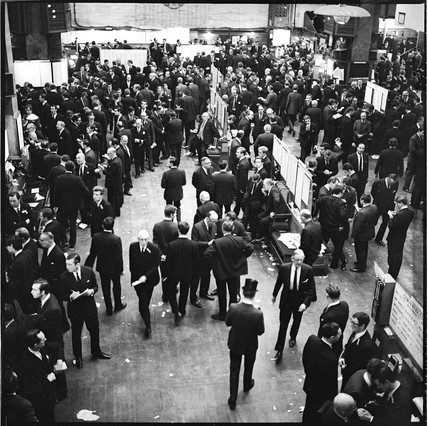
Jobbers in the LSE’s ‘Gorgonzola Hall’
Everything always takes longer than you think. Nearly two years later, I have finally published the concluding episode of ‘How to build a stock exchange’. Over 18 episodes, the podcast has offered a social history of finance as we know it today, exploring the sociology and materiality of financial markets, and showing how contemporary exchanges have evolved from local concerns to global data infrastructures. The narrative features much of my original research on the markets of London throughout the twentieth century, and a smattering of anecdotes from my own youthful experience, in the days before I realised that writing about finance was far more interesting than trying to do it.
More importantly, the podcast is an attempt to find new voices for research and to disseminate more widely the intellectual concerns of a critically-inclined management scholar. In the final episode I invoke Hunter S Thompson and the spirit of gonzo: aiming for an intimate, first person take that emphasises spontaneity and raw authenticity over form and polish, where ‘deliberate derangement of the senses… de-familiarises reality, opening the door to paradoxically clearer perceptions, a twisted perspective..’ (I borrow the words of literary scholar Jason Mosser). An honest telling of our own stories, I suggest, is the best way we have of finding our moral compass in this complicated world; it certainly seems to have more integrity than writing critical articles about four-star journals in those same four-star journals. It is, says José Ossandón of Copenhagen Business School, a ‘genre-widening event’:
Listened final episode of @Philip_Roscoe's podcast. Lot to think, this I can say for now. It is a genre widening event. Not only does it challenge the understanding of stories in finance, but also how we in the social sciences tell stories about finance @JCultEcon@Val_Studies
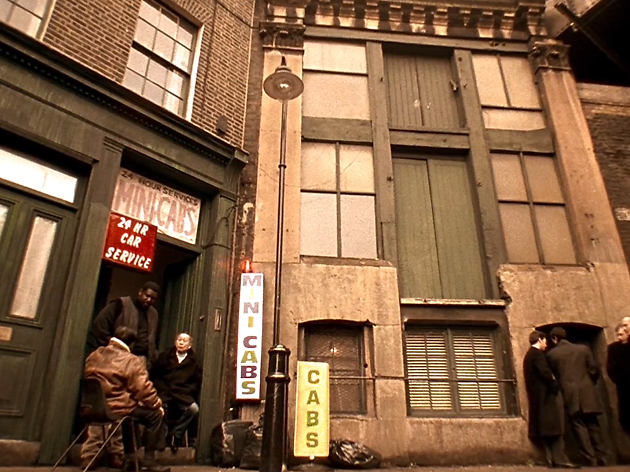
Dotcom London, the fringes thereof (as seen in ‘Lock Stock’)
So the podcast zoomed between my own research, the rich offerings of the field of the social studies of finance, and a curious selection of anecdotes from the field: breakfast with some global heavies in the Cadogan Hotel (episode 15), malicious croquet and business angels (episode 4), surfing the fringes of dotcom London (episode 13) from stuffy offices behind the sooty Victorian ironwork of the still functioning Borough Market, all rats and squashed vegetables. London in the 1990s seems a world away, containing both the promise of a unbounded global world and the seeds of the present globalised mess that we find ourselves in. Along the way it explored themes such as gender inequality in financial markets (episode 10) and the murky history of finance and slavery (episode 17). The latter topic, written in response to the Black Lives Matter movement, explored Liverpool’s burgeoning financial sector and the narrator’s own connections to the city. It led to an article in The Conversation, ‘How the shadow of slavery still hangs over global finance’. In July 2020, I was invited to address an audience of US policymakers and regulators, alongside Commissioner Rostin Benham of the US Commodity Futures Trading Commission, to discuss a possible exchange for recyclable materials, and I talk more about this possibility features in the final episode.
The podcast has been downloaded twelve and a half thousand times and the transcriptions accessed a further ten thousand times. The Guardian’s Aditya Chakrabortty described the podcast as ‘brilliant and searching’, while others said ‘beautifully told, fascinating, and very important’ (Dr Paul Segal, Kings College London), ‘an absolutely wonderful way of disseminating research’ (Dr Kristian Bondo Hansen, Copenhagen Business School), and – my favourite – ‘overwhelmed at how good this podcast is’ (Guppi Kaur Bola, activist and writer, Chair JCWI).
I listened to this a few days ago. It is brilliant and searching and says a lot about how slavery has left its imprint on our finance sectors and our societies. Listen to the end: Philip Roscoe does not lack for self-knowledge. https://t.co/qszCUio2hB
Perfect for my morning bike ride to work. Drove a little slower to get the full episode. This is, in my opinion, an absolutely wonderful way of disseminating research. Well done, @Philip_Roscoe!
Its @DecolonisingE Reading Week this week+Im having such a blast. Can't wait to share all the excellent pieces we're getting through. Beginning with a deep dive into the colonial history of the financial system + so overwhelmed at how good this podcast is https://t.co/6u1VFR3PZ7
Here’s my new project: a podcast! It’s titled How To Build a Stock Exchange: Making Finance Fit for the Future. It’s a story of stock markets and how they came to be so important in our world. It will feature my own work and showcase the research of the sociological studies of finance as it builds an account of the evolution of financial markets and their place in a responsible, sustainable future. I introduce it as follows:
Finance matters. We’re off to build a stock exchange, but first of all I’ll spend a little time explaining why financial markets matter. This episode explores how financial markets – a crucial mechanism for the distribution of wealth – are implicated in our present political malaise and looks at some of the ways that finance has squeezed us over the last three decades.
Episode One is called ‘Finance Matters and here’s how it starts…
A famous philosopher once said – ‘It is not from the benevolence of
the butcher, the brewer, or the baker, that we expect our dinner, but
from their regard to their own interest.’ It was Adam Smith, of course,
born not far down the road from me in Kirkcaldy, Scotland, and the
father of modern economics. He once walked to neighbouring Dunfermline
in his dressing gown, apparently, so deep was he in thoughts, musings
like this, and ‘Nobody but a beggar chuses to depend chiefly upon the
benevolence of his fellow-citizens.’
From those words, published in 1776, a whole global order has sprung.
We can call it capitalism, and at its centre lies a strange entity, so
much part of our lives that we simply take it for granted.



 Philip Roscoe