In March and April 2025 I was fortunate enough to spend a month in Canberra as a visiting fellow at The Australian National University’s prestigious Research School for Social Sciences. Fine colleagues in the School of Sociology made me welcome and Canberra delighted me, with its lake, trees and hot air balloons. But a highlight was a public lecture I gave on 26 March 2025, recorded by ABC National, and I’m sharing the script here. The radio recording precluded slides, so I’ll add in some images that I might have used. Enjoy!
Canberra is famous for its autumn hot air balloon rally!
Good evening, thank you all for coming tonight, and for that generous introduction. I’d like to thank the Research School for Social Sciences for offering me a fellowship, and the chance to spend a month in Canberra; to the Journal of Cultural Economy for the not inconsiderable contribution of getting me here; and to colleagues in the department of sociology and the department of management for the warm welcome that I have received over the last weeks. Thank you also to ABC Radio National for recording this lecture.
A generous introduction from Professor Melinda Cooper
I too would like to acknowledge that we are meeting on land belonging to the Ngunnawal (Nunnawal) and Ngambri (nambri) people, to recognise that sovereignty was never ceded, and to pay respect to their Elders past and present.
The acknowledgement of country seems to me, a visitor from the other side of the world, a welcome recognition and acceptance of the difficult history of colonialism. In that same spirit of recognition, I would like to take you from a massacre to a legal trial and a personal connection to the murky history of finance, which can – should you wish – be told as a history of colonial exploitation. Indeed, even if you don’t wish, it still must be.
As we muster our scholarly resources to try and figure out what is what in the brave new world that we have tumbled into – have been tumbling into for a while, perhaps – here are three things from the archives that might have something to say. Two of them are book chapters, so they haven’t had the airtime that they perhaps deserve. They were published a few years ago and so I’m reproducing them here. The third is a BBC radio essay from 2011, The Entrepreneur.
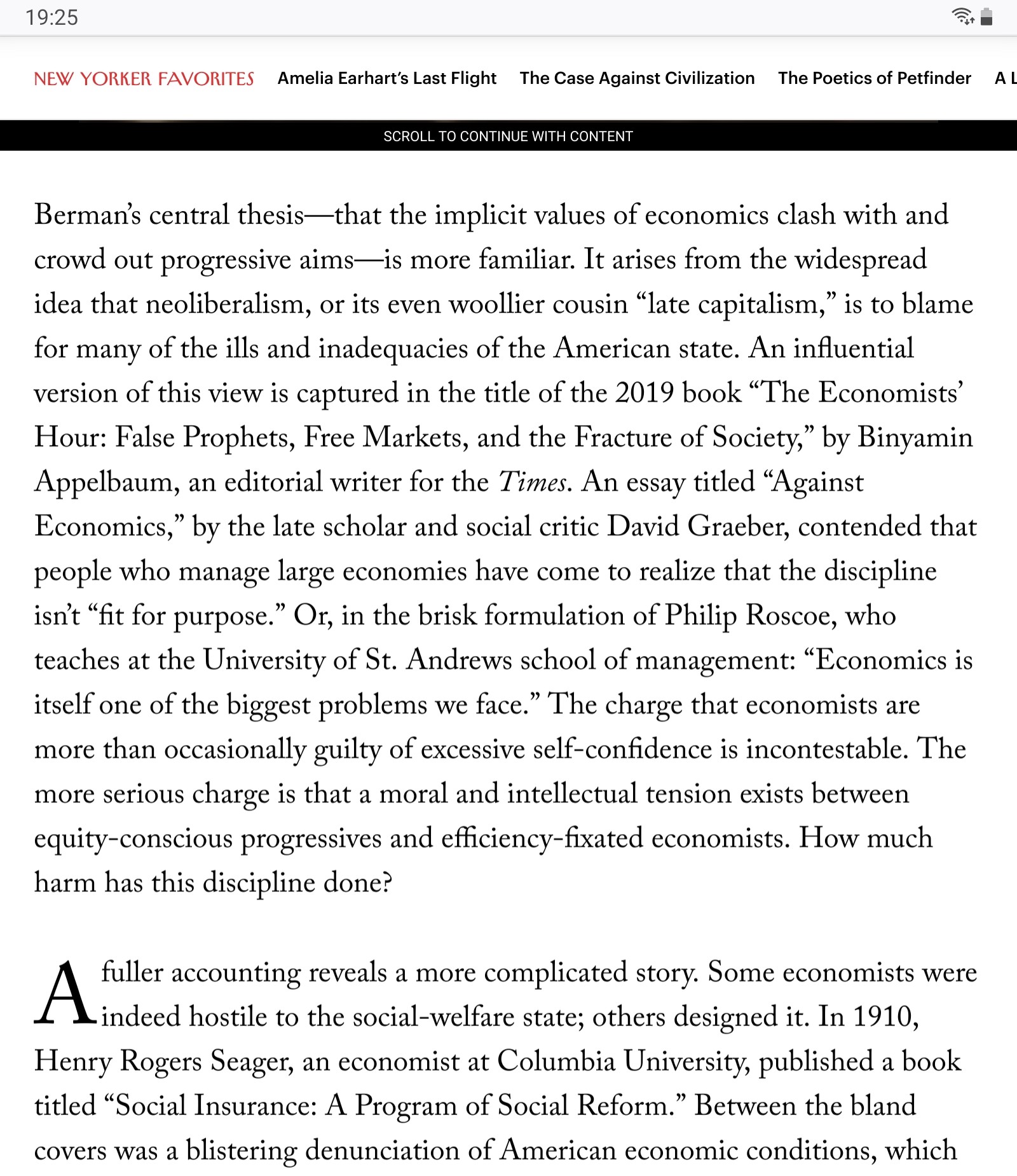
It’s not every day one is quoted – not just mentioned but quoted! – in a publication as eminent as The New Yorker, so you will forgive me for adding it to the scrapbook. The article, a review of Elizabeth Popp Berman’s new book ‘Thinking Like an Economist: How Efficiency Replaced Equality in US Public Policy‘ has me mentioned next to the late great David Graeber. We are the obligatory econ-hating-lefties in Idrees Kahloon’s ‘war on economics’ (see left) but still. I’m very glad to be in Graeber’s company, too.
And here we are – the evidence. I’ll lay my hands on a paper copy soon!
The line itself comes from a blog I wrote for the LSE back in 2014, following the publication of my book I Spend therefore I Am (Viking, 2014, republished by Penguin as A Richer Life, 2015, and now available for less than a fiver, so knock yourself out). The book ruffled a few feathers among reviewers, just as Elizabeth Popp Berman seems to have done, and the blog was something of a reply to critics. Here it is:
In January 2019 I decided it might be interesting to have a go at doing a podcast. There’s something enticing about jumping into the podcast space, crowded though it might be, the thought that you can record a few words and the next thing find yourself available on iTunes, Spotify, and other such platforms. So I bought myself a microphone, read up on the necessary infrastructure, drew a logo, sketched out a plan of what I might say. I’ll have it all wrapped up by the autumn, I thought.
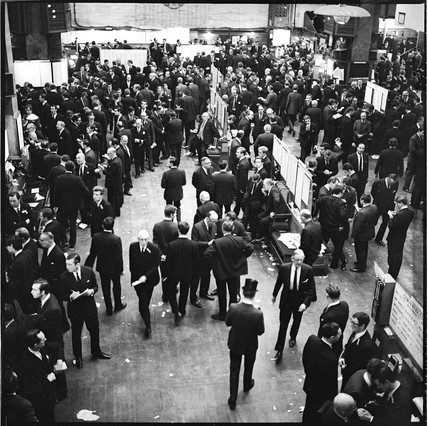
Jobbers in the LSE’s ‘Gorgonzola Hall’
Everything always takes longer than you think. Nearly two years later, I have finally published the concluding episode of ‘How to build a stock exchange’. Over 18 episodes, the podcast has offered a social history of finance as we know it today, exploring the sociology and materiality of financial markets, and showing how contemporary exchanges have evolved from local concerns to global data infrastructures. The narrative features much of my original research on the markets of London throughout the twentieth century, and a smattering of anecdotes from my own youthful experience, in the days before I realised that writing about finance was far more interesting than trying to do it.
More importantly, the podcast is an attempt to find new voices for research and to disseminate more widely the intellectual concerns of a critically-inclined management scholar. In the final episode I invoke Hunter S Thompson and the spirit of gonzo: aiming for an intimate, first person take that emphasises spontaneity and raw authenticity over form and polish, where ‘deliberate derangement of the senses… de-familiarises reality, opening the door to paradoxically clearer perceptions, a twisted perspective..’ (I borrow the words of literary scholar Jason Mosser). An honest telling of our own stories, I suggest, is the best way we have of finding our moral compass in this complicated world; it certainly seems to have more integrity than writing critical articles about four-star journals in those same four-star journals. It is, says José Ossandón of Copenhagen Business School, a ‘genre-widening event’:
Listened final episode of @Philip_Roscoe's podcast. Lot to think, this I can say for now. It is a genre widening event. Not only does it challenge the understanding of stories in finance, but also how we in the social sciences tell stories about finance @JCultEcon@Val_Studies
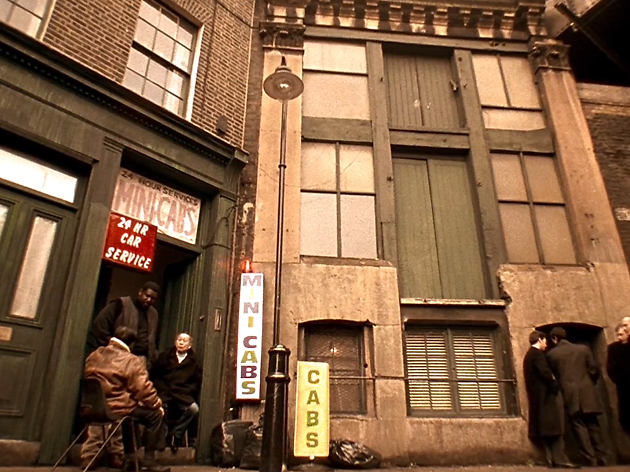
Dotcom London, the fringes thereof (as seen in ‘Lock Stock’)
So the podcast zoomed between my own research, the rich offerings of the field of the social studies of finance, and a curious selection of anecdotes from the field: breakfast with some global heavies in the Cadogan Hotel (episode 15), malicious croquet and business angels (episode 4), surfing the fringes of dotcom London (episode 13) from stuffy offices behind the sooty Victorian ironwork of the still functioning Borough Market, all rats and squashed vegetables. London in the 1990s seems a world away, containing both the promise of a unbounded global world and the seeds of the present globalised mess that we find ourselves in. Along the way it explored themes such as gender inequality in financial markets (episode 10) and the murky history of finance and slavery (episode 17). The latter topic, written in response to the Black Lives Matter movement, explored Liverpool’s burgeoning financial sector and the narrator’s own connections to the city. It led to an article in The Conversation, ‘How the shadow of slavery still hangs over global finance’. In July 2020, I was invited to address an audience of US policymakers and regulators, alongside Commissioner Rostin Benham of the US Commodity Futures Trading Commission, to discuss a possible exchange for recyclable materials, and I talk more about this possibility features in the final episode.
The podcast has been downloaded twelve and a half thousand times and the transcriptions accessed a further ten thousand times. The Guardian’s Aditya Chakrabortty described the podcast as ‘brilliant and searching’, while others said ‘beautifully told, fascinating, and very important’ (Dr Paul Segal, Kings College London), ‘an absolutely wonderful way of disseminating research’ (Dr Kristian Bondo Hansen, Copenhagen Business School), and – my favourite – ‘overwhelmed at how good this podcast is’ (Guppi Kaur Bola, activist and writer, Chair JCWI).
I listened to this a few days ago. It is brilliant and searching and says a lot about how slavery has left its imprint on our finance sectors and our societies. Listen to the end: Philip Roscoe does not lack for self-knowledge. https://t.co/qszCUio2hB
Perfect for my morning bike ride to work. Drove a little slower to get the full episode. This is, in my opinion, an absolutely wonderful way of disseminating research. Well done, @Philip_Roscoe!
Its @DecolonisingE Reading Week this week+Im having such a blast. Can't wait to share all the excellent pieces we're getting through. Beginning with a deep dive into the colonial history of the financial system + so overwhelmed at how good this podcast is https://t.co/6u1VFR3PZ7
A couple of years ago I jotted down a step-by-step guide to help my son get started on his university essays. That’s always the most difficult bit of writing – starting – and it never gets any easier. I thought some other might find it useful as well, so I’ve put it on a short video. Have fun! Beware, last minuters: the first step is ‘start early’.
I hope this helps avoid a few essay crises. If you like it, pass it on! PS: you don’t have to go to the bar in step 12 if you don’t want to.
Academics are on strike, again. The marketization of universities, with the accompanying metrification of academic labour, has come in for plenty of scrutiny both from colleagues and commentators. We can see clearly that the whole package of market relations degrades our working conditions, our security, and constitutes an assault on our profession. That’s what the action is about. But these finer points still appear to be tricky for some to comprehend. Yesterday The Guardian reported that Universities are likely to be the next in line for Dominic Cummings’ special treatment, explaining that:
‘A recent report by the rightwing Policy Exchange thinktank, founded by Michael Gove and seen as close to government thinking, said the higher education sector was seen as “out of touch” and “a sitting duck” for the new government. It claimed universities had lost “the faith of the nation in some critical areas” and flagged familiar ministerial concerns about failures to protect freedom of speech on campus, so-called “low quality” degrees that offered poor economic returns for students, excessive vice-chancellor pay and degree grade inflation.’
The irony! Michael Gove’s own right wing think tank complaining about universities acting exactly as instructed by a decade of government diktats! For as surely as night follows day, these very concerns – grade inflation, overpaid VC’s, and lightweight courses – follow from the very market structures that have been imposed on the sector.
I wrote this in December 2019, facing a general election bogged down in Brexit, anti-Semitism, and dog-whistle politics; worn out by helplessness at the end of a year of political despair. The gains hard-won through our last industrial action seemed to be slipping away, our employers refusing to budge and the trustees of our pension funds treating us with contempt. We were furious. We took strike action for eight days and things changed. Talks restarted. We saw an apparent willingness to listen and heard sympathetic noises on matters that won’t cost too much or be easily tested. In the end, however, we have met with intransigence from our employers. We have made some progress, but not enough, and we are out on the pickets again. This time feels different: less anger, more quiet determination. It is difficult for all involved. I am genuinely distressed on the part of my students, who are suffering a severe interruption to their studies. I’m also persuaded by the argument that civility makes friends (thank you Dr Fergus Neville!) and we are standing on the picket lines with new comrades.
I took this post down for a while to reflect. But I see the very tactics that so provoked me played out on grander stages. In politics, for example, our Prime Minister urges us to be friends and unite Britian as he forces through the most divisive and hard-right political agenda in living memory. Be nice too easily means be quiet; civility remains a potent mechanism of control. We Brits are just too damn polite, overburdened by our bourgois heritage.
So here it is again in (nearly) all its intemperate rage…
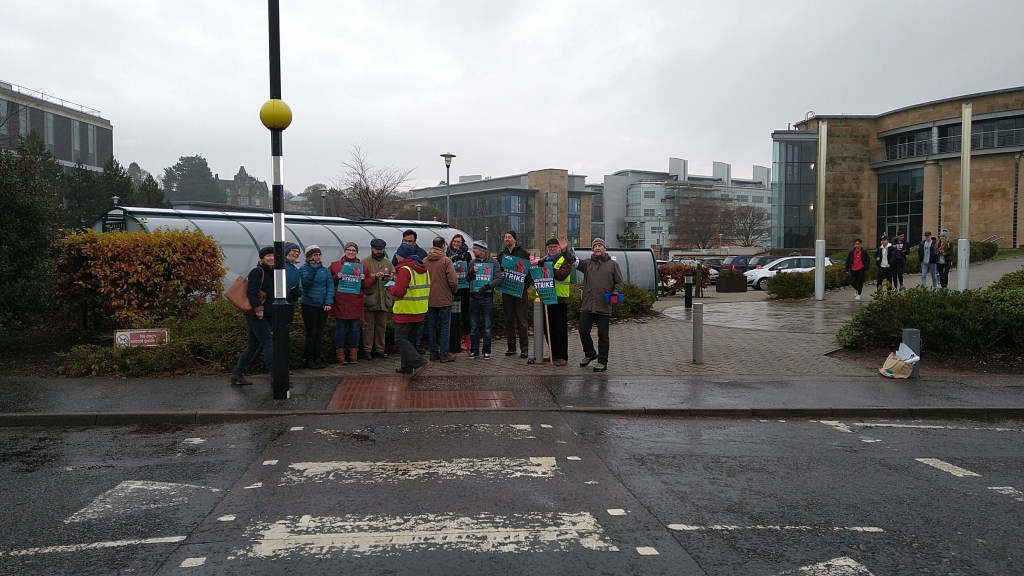
It’s Monday, noon. The morning has gone well: big turnouts on the picket lines, much solidarity from colleagues and students. In east Fife we stood in the fog and the dreich, and the bagpipes played; Stephen Gethins, our MP, turned up and wished us well and fussed my dogs, who are now staunch SNP hounds; our twitter is flooded with pictures of pickets and placards. The Second Great University Strike is underway. And now I’m home. It’s quiet, the dogs are sleeping off their exertions, and I am at my keyboard; I have things that I am trying to think through and, academic that I am, I do not know how else to do so. Strike writing.
The topic in hand is civility. Specifically, the repeated injunction from the institutions for which we work that we should approach this dispute in a ‘civil’ manner. At the risk of boring the reader, let’s recap for a moment why we are striking: a sustained assault upon our pension scheme, a significant real term drop in our salaries, inequalities of race and gender, casualization, temporary contracts, general workload and the accompanying audit practices. These are just the headline-grabbers that the union put on the ballot paper. Our profession is in tatters, with stress and overwork rife. Everywhere I hear that enough is enough, that something has snapped, that the social contract around higher education is not so much broken as in smithereens. Our employers’ refusal to negotiate has driven us to industrial action where we stand to lose eight days of salary in the run-up to Christmas. I am sure I am not alone in feeling pretty uncivil about this whole affair.
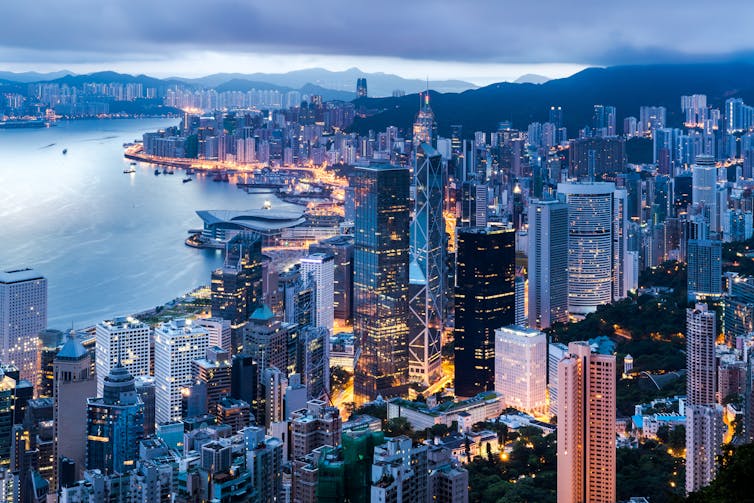
Protests in Hong Kong have captured the world’s attention in recent weeks, with demonstrators closing streets and the airport, and Chinese forces amassing near the border with a none too subtle threat of violent reprisal. The protests began in response to a new extradition law, but have spilled over into a general unease about the future of Hong Kong’s special administrative status.
This special status sets Hong Kong apart from mainland China in a number of ways. As well as enjoying various social and political freedoms, it has a free market economy and is one of the world’s biggest financial centres. Global finance has attracted a number of Chinese elites but has not benefited a large chunk of Hong Kong society.
But if Hong Kong’s protesters succeed in pushing back against the oversight of Beijing, it would serve to reinforce the benefits the elites already enjoy from Hong Kong’s economic arrangements. This parallels the situation in the UK, where financial elites could soon embrace a low-tax, low-regulation future following a no-deal Brexit driven by populist concerns about immigration and inequality.
Longstanding financial centres
Hong Kong and London share a common history and since the 1960s have flourished as offshore financial centres, acting in many ways as secrecy jurisdictions or tax havens.
Hong Kong’s financial sector was a creation of the British, who used it as a route into Chinese markets. It boomed following the opening of the Chinese economy. When, in 1997, Hong Kong returned to China, it preserved some of this offshore status as a special administrative zone. The beneficiaries this time were Chinese.
Hong Kong stores great reserves of capital in comparative secrecy, channels global investment into China – also in secrecy – and is a crucial part of China’s long-term plan to establish the Renminbi as a global reserve currency through offshore markets. The local “dim sum bond market”, issuing RMB denominated debt, has been a remarkable success, with the equivalent of more than US$100 billion of capital circulating.
Hong Kong has been implicated in shadier dealing. Investigative journalist Nicholas Shaxton puts it bluntly: “Hong Kong is where most of the corruption in China is accomplished.” Other scholars see Hong Kong as an amalgam of onshore and offshore finance, with a strong legal system, tax treaties, and a robust financial market.
London’s success as a global financial centre has also been driven by its status as a hub for offshore financial services, a position greatly supported by its strong connections throughout Britain’s former empire. In the 1960s and 1970s, for example, London became home for the “eurodollar” markets. These were lending markets operating in US dollars, located in London but considered to be beyond the purview of the UK’s legislation.
London-based lenders could charge higher rates than the national currency controls of the time allowed. The United States benefited as the depth and liquidity of eurodollar markets supported the dollar’s reserve currency status; international banks arrived in droves and the City, London’s financial district, thrived. Regulators on both side of the Atlantic turned a blind eye, quietly admitting the economic benefits the markets bestowed. Even the Soviets invested.
Masters of reinvention
Both London and Hong Kong are centres of perpetual reinvention. Following the financial crisis, the City’s innovations have included managing the wealth of the global super-rich and an arrangement with the Chinese government to develop the offshore trading of the RMB.
In the same way that Hong Kong’s protesters fear Chinese control, a number of Brexiters claim the EU comes with too much red tape. Interviewing financiers for research into London-based markets, I found overwhelming support for Brexit, largely driven by a distaste for increasing layers of regulation.
It is certainly the case that Europe has never been comfortable with London’s activities as a conduit for international funds. No one expects the EU to maintain the City’s “passporting rights” which allow firms based in the UK to trade freely across the EU. And the mundane but profitable business of settling euro transactions is likely to be pulled within the bloc.
But there is much more to financial markets than regulation. The City’s remarkable talent for reinvention flows from the nature of financial markets themselves.
History shows they are fluid entities constantly reshaping in response to political happenstance and technological or economic advances. Markets put down roots in the shape of dense social networks shaped by bonds of trust and expertise, and in the material infrastructures – from wires, phones and screens to upscale offices, restaurants and hotels – without which they cannot function. Advantages of status and connection become embedded. When new financial frontiers open up it’s those well-placed who benefit.
Here’s the irony. Hong Kong’s protesters seek political freedom, but whatever happens in politics, it is likely that the economic advantages of the elite will be preserved through the social and material architectures of its markets.
Brexit, meanwhile, has been driven by concerns over immigration and inequality, but the no-deal on the horizon offers something else. If the new prime minister’s rhetoric of “boosterism” and “freeports” is to be believed, the City will be entirely unencumbered by regulation, free to roam the high seas of international currency flows. Here too, only the financial elites will benefit.
Our pensions are under threat. You will be familiar with the headline numbers – pensions slashed by over half, to a level where the very survival of the university sector seems in jeopardy. I have done the numbers, like everyone else, and they make grim reading. But how did this whole mess come about? At root, it’s a struggle over risk and who should carry it. The deficit itself is the result of some particular choices made by regulators and administrators. Its very existence is a reflection of the broader struggles over the marketizing of universities and the social contract for public services, and it’s this battle that academics are fighting, whether we know it or not. Continue reading “Deficit, what deficit? The politics of financial fact”





 Philip Roscoe