
Well, it was a busy 2025, but that’s no excuse. So here it is. On 19 February 2025, I was honoured to take part in an inaugural lecture showcase for the University of St Andrews Business School, alongside my colleagues Professors Alina baluch, Shiona Chillas and Ian Smith. We were introduced by the Principal, Professor Dame Sally Mapstone, while Dean of Arts Professor Catherine O’Leary was our MC. A very special, happy event, followed by a dinner in Upper College Hall.
The lecture has since been published as a commentary piece – and call to action – in the Journal of Cultural Economy, which I edit. It’s open access, available here or as a PDF.
For those who prefer, here’s the text and a few pictures:
“The times they are a-changin’: markets after neoliberalism, and how to study them”
You will doubtless know that it is possible, in the run up to Christmas each year, to take a day trip to see Santa Claus in his cottage in Lapland.[i] You and your children hop on an aeroplane and over the next few hours you are transported into a magical world of snowy forests, sleighs, and reindeer – not to mention merchandising opportunities – until, much later that day, you tumble back into Birmingham, Manchester or Gatwick, pockets empty but memories overflowing.
If you believe in Santa, you should probably stop listening now. For this particular market, offering an authentic Santa experience, is an enormously complicated organisational achievement. A network of local operators serves it: the husky tours, snowmobile transport, hotel and gift shop, buses, and the other paraphernalia of tourism. The actors playing Santa are recruited in the UK so that they will be familiar with the latest trends of the toy market and responsive to the vernacular demands of their small visitors. Authenticity is key, lest the visitors complain (again) about ‘a posh English Santa with a false beard.’
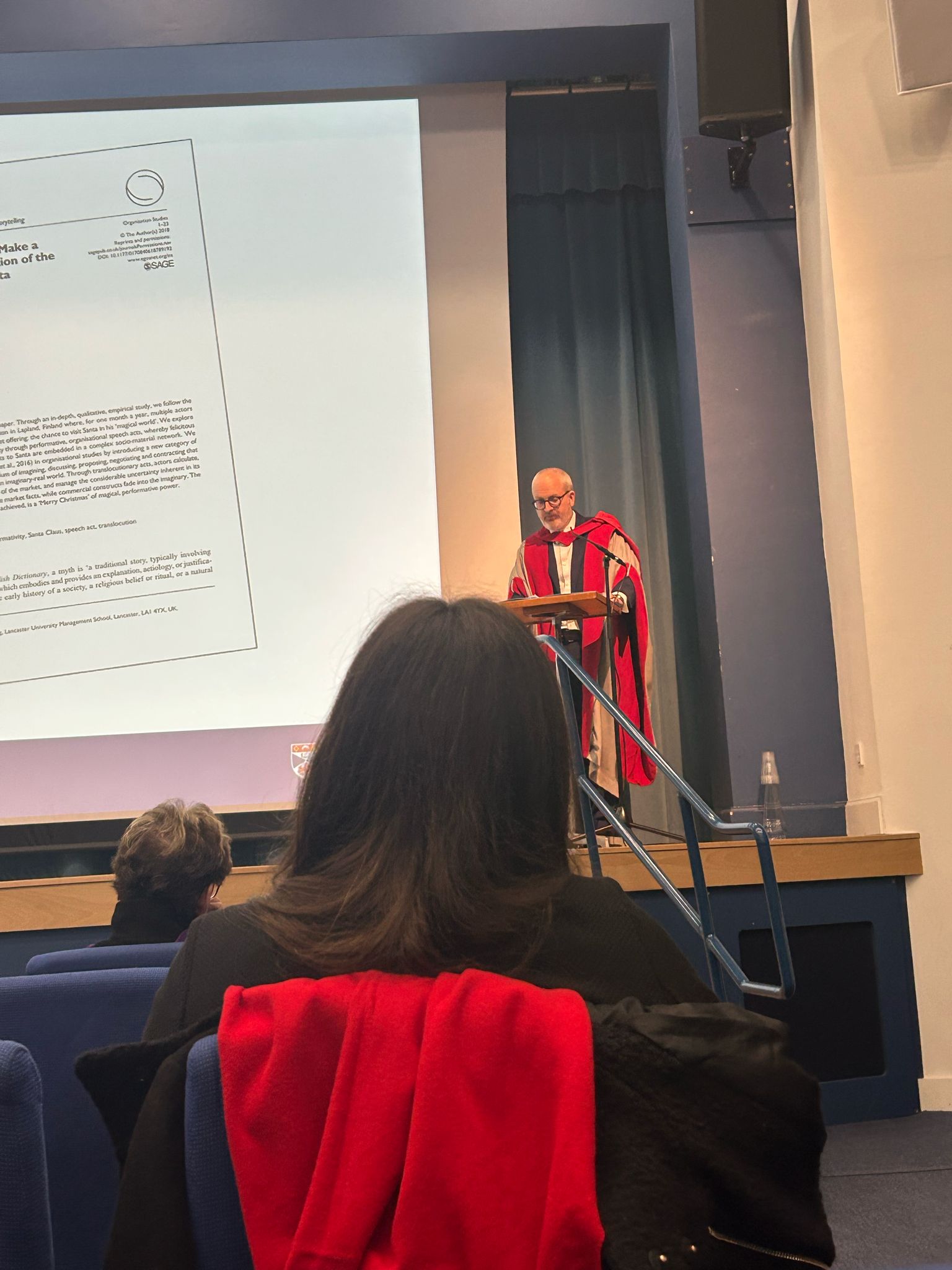
The whole is immaculately choreographed. Tourists take a sleigh ride across the frozen lake into the torchlit forest. Elves shepherd them into the cottage for a carefully scripted four-minute encounter with the man himself, out again into the sleigh, and back through the forest, tears in their eyes at the whole magical performance. Some days two flights arrive from different airports. On those days there are two Santas at work, hidden in different locations in the wood, managed by different circuits of elves, the passengers themselves identified by coloured badges on the lapels.
Continue reading “My inaugural lecture – a year late!”

 Hot on the heels of my last review – of
  ‘Certain questions dog progressive thought: why, in view of the manifest failures of financial capitalism, is its hold on our society stronger than ever? Why, despite the empirical evidence of foreclosures, vacant building lots and food banks are people unable to see the catastrophic consequences of current economic arrangements? How has neoliberalism emerged from calamity ever stronger (Mirowski, 2013)? Why, as Crouch (2011) puts it, will neoliberalism simply not die? With this slim book Martijn Konings, a scholar of political economy at the University of Sydney, sketches out an answer: that progressive understandings of capitalism have neglected its emotional logics – its therapeutic, traumatic-redemptive, even theological qualities – and failed to recognise our emotional investment in money, our belief in the social role of credit as an ordering, regulatory mechanism, and our need for the redemptive promise of austere, well-disciplined economy… ‘
 Philip Roscoe